Using Jupyter (Need), Exercises
Exercise 1 (Put it in Markdown) ☻
1 Quadratic Equations
Introduction
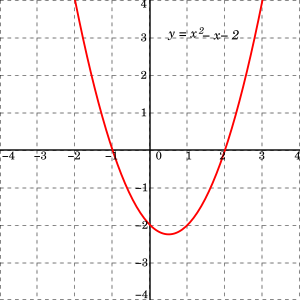
(Image from the Wikipedia page on Quadratic equations)
The general form of a quadratic equation is:
\[ ax^2 + bx + c = 0 \]
Solutions
Provided \(a\ne0\), we can use an elementary algebraic method called completing the square to show that a quadratic equation has the following solution: \[ x = {-b \pm \sqrt{b^2-4ac} \over 2a} \]
Discriminant
The quantity \(\Delta = b^2-4ac\) is called the discriminant of the equation and decides the nature of its solutions. The table below shows the various possibilities.
| Discriminant | Roots |
|---|---|
| \(\Delta = b^2-4ac = 0\) | A single solution of \(-b/(2a)\) |
| \(\Delta = b^2-4ac \gt 0\) | Two distinct solutions |
| \(\Delta = b^2-4ac \lt 0\) | No real solutions; both are complex. |
Use a Markdown cell to reproduce the short introduction to quadratic equations presented in the Result tab.
Exercise 2 (In Your Own Words) In your own words, use a Markdown cell to answer the following question.
If you are unsure of the answer, please first consult with an instructor or a friend. Only then should you use the internet for additional information
- What is a Git repository?
- Git keeps track of ____BLANK____ in the files in our repository.
- What is a commit?
- What is a push?
- What is a pull?
- What is the difference between GitHub and GitHub Desktop?
Exercise 3 (A Matter of Statistics) The mean (\(\mu\)), standard deviation (\(\sigma\)), and Pearson correlation coefficient (\(r\)) are important statistical parameters. Given variables \(x_i\) and \(y_i\) representing the \(i\)-th values in a dataset with \(n\) pairs, use Markdown notation to write the equations for these parameters.
Your equations should ideally look like the following. You might find this resource from Rice University useful.
\[\begin{align} \mu &= \frac{1}{n} \sum_{i=1}^{n} x_i\\ \sigma &= \sqrt{\frac{1}{n} \sum_{i=1}^{n} (x_i - \mu)^2}\\ r &= \frac{\sum_{i=1}^{n} (x_i - \mu_X)(y_i - \mu_Y)}{\sqrt{\sum_{i=1}^{n} (x_i - \mu_X)^2 \sum_{i=1}^{n} (y_i - \mu_Y)^2}} \end{align}\]