Overview
Welcome to the 2nd part of 73!
Your 73 journey so far has been heavily scaffolded with much hand-holding. You now need to gradually practice applying the knowledge gained so far to solve problems independently. The second half of 73 will facilitate this in two steps. The first (Application Challenge) will get you to work on a given problem. The next step (Mini Project) will allow you more freedom to pick a problem of your choice. Since this can still be overwhelming to handle individually, you will work in groups to help each other whenever possible.
Learning Objectives
There are many benefits to be reaped from the second half of the course. The ones I am focussed on are:
- Appreciate the breadth of possibilities that computational techniques can unlock.
- Engage in collaborative work to effectively utilise each group member’s strengths, thereby collectively accomplishing the assigned tasks.
- Gradually gain the confidence necessary to write your own code independently.
- Develop your ability to utilise resources from both within the course and external sources to support your learning and problem-solving.
The Structure
A new tool: Colab
Now that we focus on working as a group, we need an avenue to work collaboratively. For this, we will use a new online tool from Google called Colab. You only need a Google account to access it. More details of how and what to do appears in the chapter Hello Colab at the SPS Python Site.
You might wonder why we are not using GitHub and ReviewNB for this. While Git and GitHub are top-class tools, I am concerned that learning the mechanics of using them (pushing, pulling, resolving conflicts, and merging) might distract you from Python and science, given you have only about four weeks for the Application Challenge and Mini Project.
Applications
You should take a peek at the ‘Applications’ at the SPS Python site. This is a collection of examples where programming (in the guise of Python) is used for scientific purposes. These should give you a flavor of what computing can do for science. The material in Applications secton is more or less self-contained.
You are not meant to consume all of the material in the Applications. Instead, pick and choose items that interest you and are relevant to the Application Challenge. You might have to learn a thing or two from one part to make sense of another. How deeply you want to do this is up to you.
Other important details
Always remember the individual viva
Please bear in mind that the content of the second half will be central to the individual viva. So, as a group member, you should be nurturing and mindful that all your group mates keep up and understand what is happening. As an individual, you should ensure that you are abreast of everything done or submitted by the group. Come the second viva(which is 20% of your grade), you will have to defend this content on your own.
The importance of working in a group
Teaching and discussing concepts with your peers offers clear mutual benefits, sometimes referred to as “Giver’s Gain” (see Kobayashi (2019) and Koh, Lee, and Lim (2018)). Group work also offers a chance to develop and hone vital communication and strategic skills that will be invaluable for future endeavours. Working together on a problem is a great learning experience. It lets you see how others think, learn from their ideas, and improve your own by defending your thoughts. Further research shows that STEM students who engage in learning groups perform better academically and experience improved mental well-being (Prof. Peter Felten).
For those of you who might be tempted to dismiss all this as a cliché, I would like to share how, even recently, I have (unfortunately) observed how academic collaborations break up and how graduate students quit due to challenges due to poor interpersonal skills. So, you should always welcome any opportunity to cultivate self-awareness and gain insights into your behaviour and interactions within a group. I am not suggesting that this group experience is a panacea, but it will definitely help.
I also like to distinguish between working as a group and working as a team. The former is a temporary, lukewarm marriage of convenience, while the latter is the coming together of like minds in a conducive environment of tolerance and support to achieve a goal. If you are lucky, you will also enjoy being in a team.
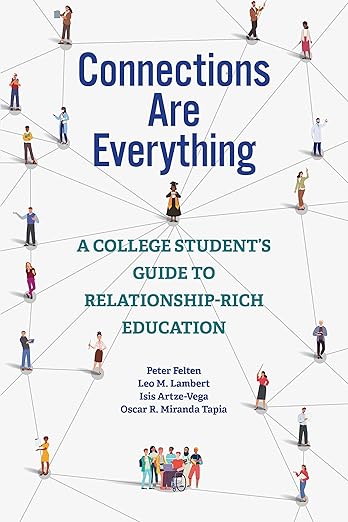
The bottom-line is the benefits of connecting with others extend far beyond academic performance. I encourage you to explore the free book Connections are Everything that had been written specifically for undergraduates such as you in mind.
Your Well-being Matter
I hope you will gain much by taking my course. I want to challenge you, but not at the cost of causing frustration or stress. Your physical and psychological well-being are far more important than mastering how to write a list comprehension. Please remember that you are not alone in this journey; a lot of us are here to help. You just need to ask.