The NUS Special Programme in Science proudly congratulates four distinguished alumni from the SPS Batch of 2021 for their outstanding achievement at the Global Undergraduate Awards, where they were recognised at the Highly Commended level.
Being recognised at the Highly Commended level places these individuals among an elite group of students worldwide. This prestigious honour celebrates academic excellence across diverse disciplines and acknowledges work that demonstrates originality, depth, and strong scholarly potential. Recipients at this level are ranked within the top ten percent of submissions globally, a testament to the exceptional quality of their research and academic contributions.
4 alumni from the SPS batch of 21 have received this award:
- Jeriel Lee Cheng Hock (Life Sciences)
- Prathyusha Raghunathan (Pharmaceutical Science)
- Lewin Raymarc Roldan Turqueza (Pharmaceutical Science)
- Nicholas Ng Wee Hao (Pharmaceutical Science)
Jeriel Lee Cheng Hock (Life Sciences)
Jeriel was recognised for his work in evolutionary developmental biology, where he established the spatial-temporal expression patterns of ten crucial early wing development genes in the model butterfly, Bicyclus anynana. By implementing a new “Rapid-Accelerated-Multiplexed-Fluorescent in situ Hybridisation” protocol to visualise these genes in a single sample, his results revealed fundamental differences in wing primordia specification between Drosophila and Bicyclus. Based on these findings, Jeriel proposed a new hypothesis for Bicyclus development involving the splitting, migration, and sub-specification of primordia into wing hinge and wing blade components.
Prathyusha Raghunathan (Pharmaceutical Science)
Prathyusha’s research addressed a critical challenge in treating neurological disorders: the difficulty of delivering therapeutics across the highly restrictive blood-brain barrier. Her project focused on the development of an innovative biohybrid nanoparticle drug delivery system designed with intrinsic capabilities to navigate the blood-brain barrier’s selective permeability. By engineering these nanoparticles to bypass traditional biological obstacles, her work aims to significantly enhance the efficiency of drug delivery, potentially improving treatment outcomes for a wide range of diseases.
Lewin Raymarc Roldan Turqueza (Pharmaceutical Science)
Lewin was recognized for his research into the genetic mechanisms of cancer cachexia (cancer-associated muscle wasting). Utilizing a Drosophila model, he worked on characterizing specific genes involved in this condition and investigated the role of cancer-derived exosomes in triggering muscle loss. His work contributes to a deeper understanding of the systemic effects of cancer, opening potential avenues for future therapeutic intervention.
Nicholas Ng Wee Hao (Pharmaceutical Science)
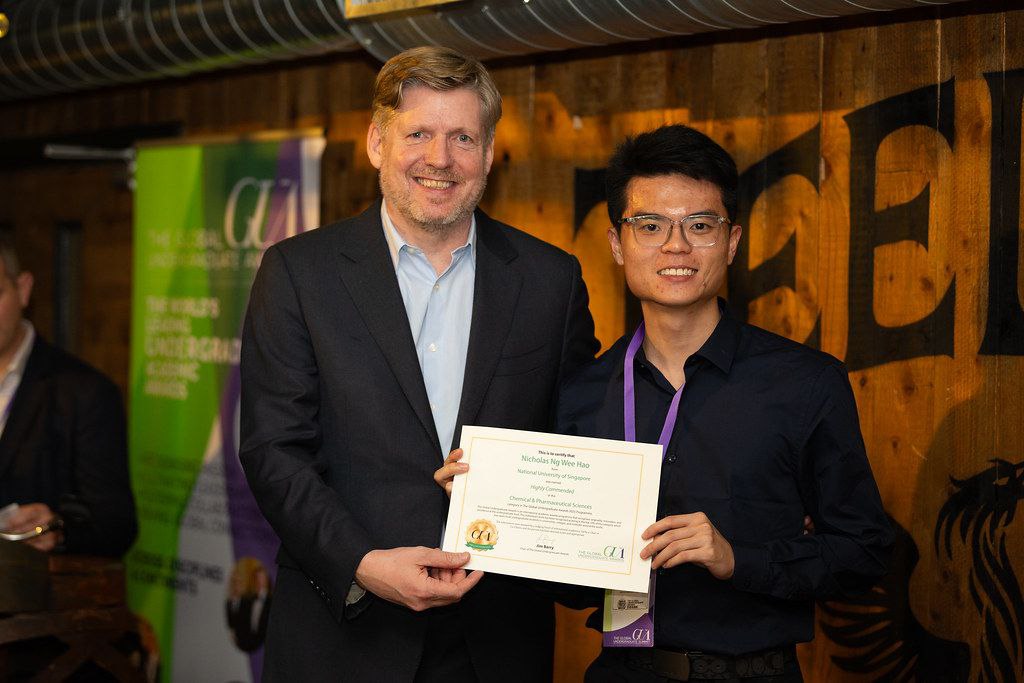
Nicholas was recognised for his innovative work in drug development, specifically the synthesis of a rotaxane-based prodrug for targeted cancer therapy. By linking anti-cancer agents with glutathione-responsive “stoppers,” his design allows for self-reporting drug release via FRET signalling. This research lays significant groundwork for the future of smart, responsive drug delivery systems.
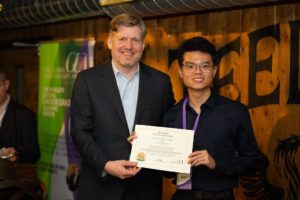
SPS Alumnus Nicholas Ng (Batch of ’21), one of the four Highly Commended recipients at the Global Undergraduate Awards.
This remarkable achievement reflects the dedication, perseverance, and intellectual curiosity that these alumni have demonstrated throughout their academic journey. Their work reflects a deep commitment to scientific inquiry and innovation, highlighting both academic rigour and a strong passion for advancing knowledge in their respective disciplines. It embodies the values that the NUS Special Programme in Science strives to cultivate in its students: a commitment to excellence, a passion for research, and a drive to contribute meaningfully to the scientific community.
The SPS community takes immense pride in their success. Their accomplishments not only bring honour to themselves but also serve as an inspiration to current and future students. We look forward to seeing their continued contributions to science and research on a global stage.